

What the customer hears
- Part of the message is known. In a private chat the assistant answers the parts the knowledge base covers and says it doesn’t have the rest. The question is still saved here.
- Nothing is known. It sends the fallback message, which promises no reply. When the assistant hands chats to the team (its hand-off rule is on), the default fallback ends with “Would you like me to pass your question to the team?”. A yes hands the chat to the team, a no lets the chat go on.
- Questions in a row it can’t answer, each within an hour of the last: the second gets “I don’t have that information either” with the offer again, instead of the same fallback. The third hands the chat to the team. Without a hand-off rule it keeps saying it doesn’t have that information either.
- The AI sends the person somewhere else. In a private chat the assistant speaks as the business, so it doesn’t tell people to call, email, use a form or website, or “contact the business directly” unless the knowledge base gives that exact number, email or link. If the AI still writes such a sentence, it is left out, the rest of the reply is sent, and the question is saved here. When the assistant hands chats to the team, the reply ends with “Would you like me to pass your question to the team?”. Telling people to come in at the address from the knowledge base is fine, and so is emergency advice such as “call 999 or go to A&E” or a form or channel the knowledge base itself mentions.
- The AI says it doesn’t know in its own words. A reply such as “I don’t have information about parking” is sent as the AI wrote it, and the question is saved here too, in English, Russian, Ukrainian, Spanish and Hebrew.
- The question is saved for the team. In each of these cases, when the question is really kept here, the reply says so in one short line in the customer’s language: “I’ve saved your question for the team.” It promises no reply and no time. The offer after it then reads “Would you like someone from the team to reply to you here?”. A question too short to keep, a public reply and the playground get no such line.
- Public comments get no reply when the answer isn’t known.
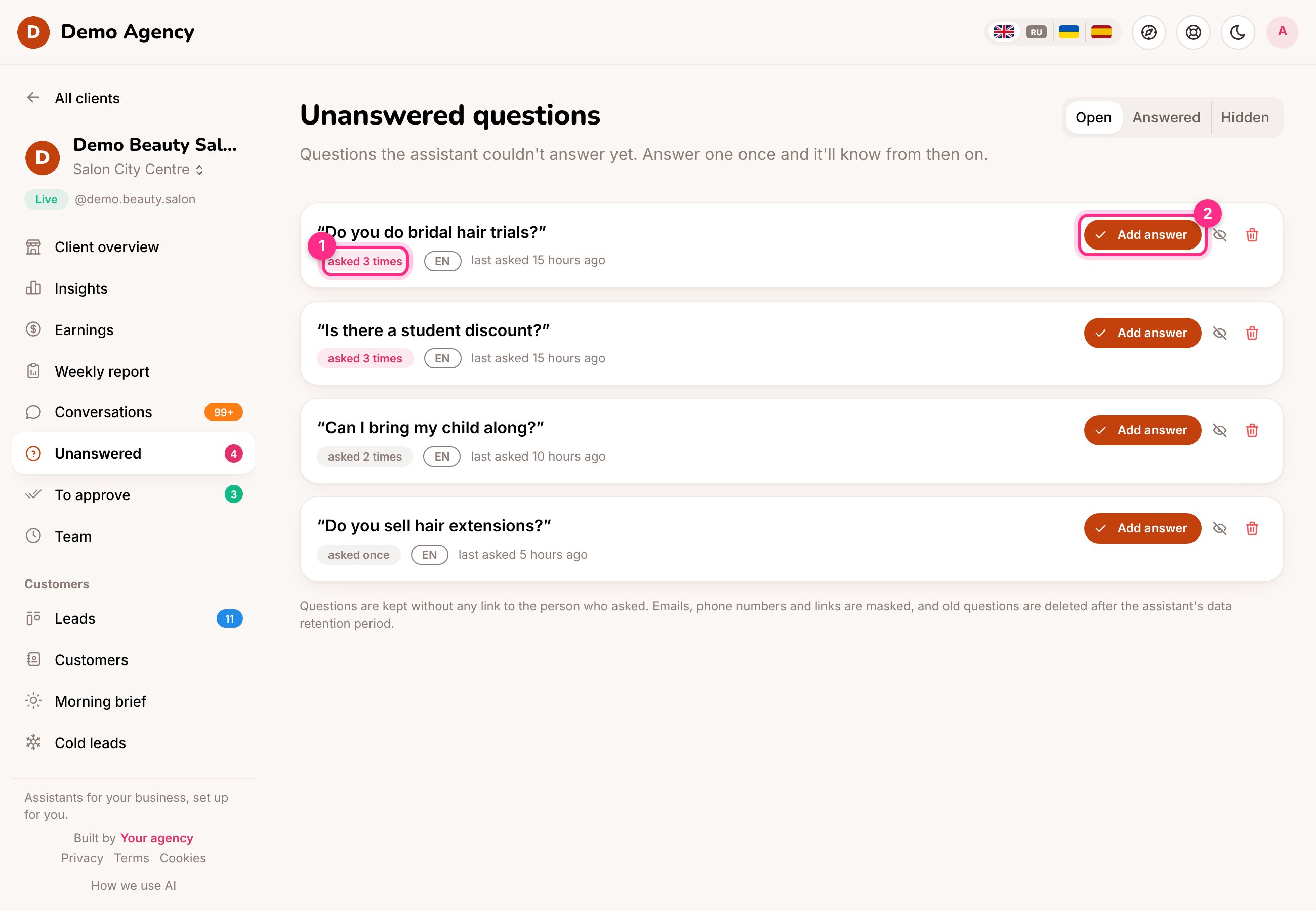
Unanswered questions: how often (1) and add an answer (2)
Answer a question
1
Click Add answer (2)
Write the answer the way you’d say it to a customer.
2
Save
The answer becomes an FAQ entry. From now on the assistant answers it.
3
Reply to the people who asked
You can send the answer to everyone who asked it in the last 7 days, so nobody is left waiting.
Business owners see this list in their portal as Questions to answer. Their answers become FAQ entries too, so the client can teach the assistant without your help.